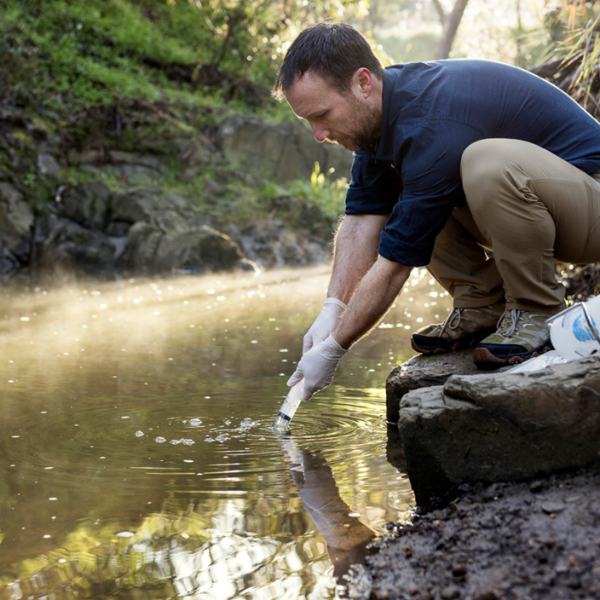
Environmental DNA (eDNA) is transforming how we understand and monitor aquatic ecosystems, offering a powerful, non‑invasive way to detect species and assess biodiversity. This course introduces participants to the science behind eDNA and its rapidly expanding role in environmental management, conservation, and waterway assessment. Through real‑world examples, participants will see how eDNA reveals ecological patterns that traditional survey methods often miss.
This two-part course is designed for participants to learn to design effective eDNA surveys, interpret qPCR and metabarcoding outputs, and apply analytical tools such as site occupancy models, detection probabilities, and species accumulation curves. Those based in Australia can optionally receive a water sampling kit to collect a sample from their local area for analysis.
By the end of the course, participants who are new to eDNA as well as experienced users will be able to confidently apply eDNA techniques in practical monitoring programs and deepen your understanding of aquatic biodiversity.
Josh is a wildlife ecologist and platypus expert and has worked across a variety of species, habitats, and regions. Having spent many years in the field, Josh is in a unique position to understand the... Read more
Course Overview
This practical course introduces participants to the power of environmental DNA (eDNA) for aquatic monitoring. Through hands‑on activities, real data interpretation, and local water sampling (optional), participants learn how to design surveys, analyse qPCR and metabarcoding results, and apply eDNA tools to understand biodiversity and support environmental decision‑making.
Learning Outcomes
In this course, you will be able to:
Understand the core principles of eDNA and how it is used to detect aquatic species and assess biodiversity.
Design and plan effective eDNA surveys tailored to different environments and monitoring objectives.
Interpret qPCR and metabarcoding outputs and apply analytical tools such as occupancy models and detection probabilities.
Analyse real biodiversity data, including optional results from a local waterway to explore ecological patterns and support environmental decision‑making.
Collect and handle water samples confidently, recognising how simple and accessible eDNA sampling can be for real‑world use.
Key Benefits
Hands‑on, place‑based learning: participants collect a water sample from a site that matters to you, creating a direct and meaningful connection to your local environment.
Surprisingly simple sampling: discover how easy it is to gather an eDNA sample without specialist training, equipment, or travel, making modern biodiversity monitoring accessible to everyone.
Real biodiversity insights: receive genuine results from your chosen creek, farm dam, or restoration site, turning course concepts into tangible, personal data.
Shared learning through real samples: participant‑submitted data becomes part of group discussions, allowing everyone to compare findings, explore patterns, and deepen understanding.
Practical skills for modern monitoring: learn how eDNA complements traditional survey methods and how to apply it confidently in environmental, conservation, and waterway management contexts.
eDNA Sampling Guide
Watch is video to get a step-by-step guide on how to collect the sample:
A sample of the kit:
Course Outline
Session 1: Achieving your Research Goals with eDNA Surveys
(Thursday, 23 July from 10 AM – 12 PM Sydney Time)
Introduction to eDNA.
Understand types of analysis: qPCR and metabarcoding.
Survey design principles for different outcomes with case studies.
Importance of repetition and replication.
Session 2: Navigating Uncertainty in eDNA Data
(Thursday, 20 August from 10 AM – 12 PM Sydney Time)
Understanding eDNA outputs from qPCR and metabarcoding analyses.
Assigning confidence to species detections.
Calculating species accumulation curves.
Occupancy modelling for spatial and temporal analysis.
Format
4+ hours of session recordings with unlimited access for 30-days.
Pre-and-post-course materials to go through via the AWS learning platform.
Homework exercises between the sessions.
Additional resources and working model download/s.
Ability to ask questions to the presenters at any time through the live sessions and via the learning platform.
Pre-requisites
No experience or prior knowledge required.
Expression of Interest (EOI) Form: How It Works
To begin your registration for the eDNA Essentials course, all participants are asked to complete a short Expression of Interest (EOI) form. This helps us confirm your details, understand your interest in the course, and determine whether you would like to take part in the optional water sampling activity.
For Australian participants
Australian‑based participants can indicate if they would like to receive an optional eDNA water sampling kit. This kit allows you to collect a sample from a local creek, farm dam, or waterway of your choice. Your sample will be processed as part of the course, and the resulting biodiversity data will be incorporated into group discussions as part of Session 2.
Please note: The cut‑off to return a kit is one week after Session 1, to ensure enough time for postage and processing.
For international participants
International participants are warmly welcomed to join the course. Due to customs regulations, the optional water sampling kit cannot be shipped outside Australia. All international participants will still have full access to the course content, hands‑on demonstrations, data interpretation exercises, and case studies.
Completing the EOI form ensures we can prepare the right materials and provide the best learning experience for everyone.
Completion Certification
Participants earn CPD hours/points (i.e. with Engineers Australia) for at least 4 hours for the entire course.
On completion of the course attendees will be issued with a Certificate of Completion.