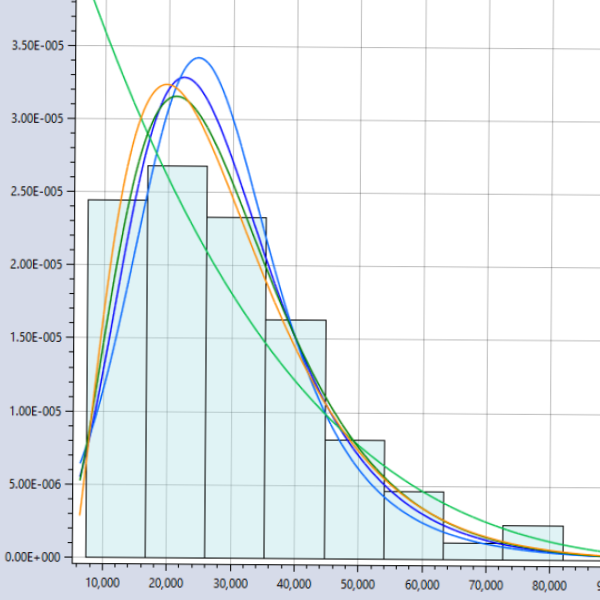
This course provides a practical, hands-on introduction to RMC-BestFit, the USACE Risk Management Center's statistical analysis software for flood frequency studies. Participants will learn how to acquire and prepare hydrologic data, perform univariate and Bulletin 17C frequency analysis, and explore advanced modelling capabilities including point process, mixture, and composite distribution analysis.
The course walks through the complete analytical workflow, from downloading time series data from international sources (USGS, Australian BoM, GHCN, CHMN) through to fitting Bayesian models with quantile priors and producing defensible frequency estimates. Participants will see how RMC-BestFit manages censored data, nonstationary trends, competing risks, bivariate copulas, coincident frequency analysis, rating curves, and time series modelling.
This hands-on course will demonstrate how to download data, create block maximum and peaks-over-threshold input data, fit univariate and point process frequency models, and estimate rating curves using real-world Australian and US gauge data, designed to build confidence in applying RMC-BestFit to practical flood-frequency challenges.
Haden Smith is a Lead Engineer with the USACE Risk Management Center, specialising in developing risk methodologies, conducting flood hazard assessments for high-priority dams and levees, and advancin... Read more
Course Overview
This course provides a practical introduction to RMC‑BestFit 2.0, guiding participants through hydrologic data preparation, frequency analysis, and advanced Bayesian modelling. Through real‑world demonstrations, participants will learn how to download and prepare hydrologic data and produce defensible flood frequency estimates for dams, levees, and flood risk management studies.
Learning Outcomes
In this course, you will be able to:
Download time series data from international sources and prepare block maximum and peaks-over-threshold input datasets for analysis.
Configure and run univariate, Bulletin 17C, and point process flood frequency analysis with Bayesian uncertainty quantification.
Apply advanced models including mixture distributions, composite distributions, and copula-based bivariate analysis.
Perform coincident frequency analysis, rating curve estimation, and time series modelling (ARIMAX).
Produce defensible frequency estimates with full Bayesian uncertainty quantification for dam and levee safety decisions.
Course Outline
Session: Comprehensive Flood Frequency Analysis with RMC-BestFit
Data acquisition and preparation: downloading time series from USGS, BoM, GHCN, and CHMN; input data types (exact, uncertain, interval, threshold); hypothesis tests and diagnostics; block maximum and POT extraction.
Core frequency analysis: stationary and nonstationary univariate models with quantile priors; Bulletin 17C (Log-Pearson III); point process models for POT data with censored observations.
Advanced distribution models: mixture distributions, composite distributions (competing risks, mixed populations, Bayesian model averaging), and copula-based bivariate analysis.
Supporting analysis: coincident frequency analysis, stage-discharge rating curve estimation, and ARIMAX time series modelling.
Live demonstrations: download BoM data and fit a LP3 univariate analysis; create POT data and fit a seasonal point process; download USGS stage-discharge data and fit a rating curve.
Format
2+ hours of session recordings with unlimited access for 30-days.
Pre-and-post-course materials to go through via the AWS learning platform.
Additional resources and working model download/s.
Ability to ask questions to the presenters at anytime through the learning platform.
Pre-requisites
A general understanding of flood hydrology, flood frequency analysis, and basic statistical concepts.
Familiarity with basic probability terminology such as return periods, exceedance probabilities, and probability distributions.
No prior experience with RMC-BestFit is required, but helpful for faster onboarding.
To learn the RMC-BestFit functionalities where our presenters’ step through their own data sets to develop flood frequency analysis, filter outliers, and incorporate non-stationarity, register for the AWS On-demand Courses: